
This guide explains what vestibular paroxysmia is, the symptoms to look out for, what causes it, how it is diagnosed and how it is treated. It also covers when you should see a specialist.
Sudden, brief spinning attacks that come and go many times a day can be frightening, especially when scans and routine tests look normal. There is often a reason for them, and it has a name.
Vestibular paroxysmia is a recognised cause of very short, repeated bouts of vertigo. It is treatable, and most people respond well once the diagnosis is made. The difficulty is that the attacks are so brief that they are easy to miss, so many people see several clinicians before anyone identifies the pattern.1
This guide explains what vestibular paroxysmia is, the symptoms to look out for, what causes it, how it is diagnosed and how it is treated. It also covers when you should see a specialist. The aim is to help you understand your symptoms and feel prepared for a conversation with a clinician, not to replace that conversation.
What is vestibular paroxysmia?
Vestibular paroxysmia is a balance disorder that causes very brief, repeated episodes of vertigo (a spinning or swaying sensation) or unsteadiness. Each attack usually lasts seconds, and rarely more than a minute, and the episodes can occur many times a day.1
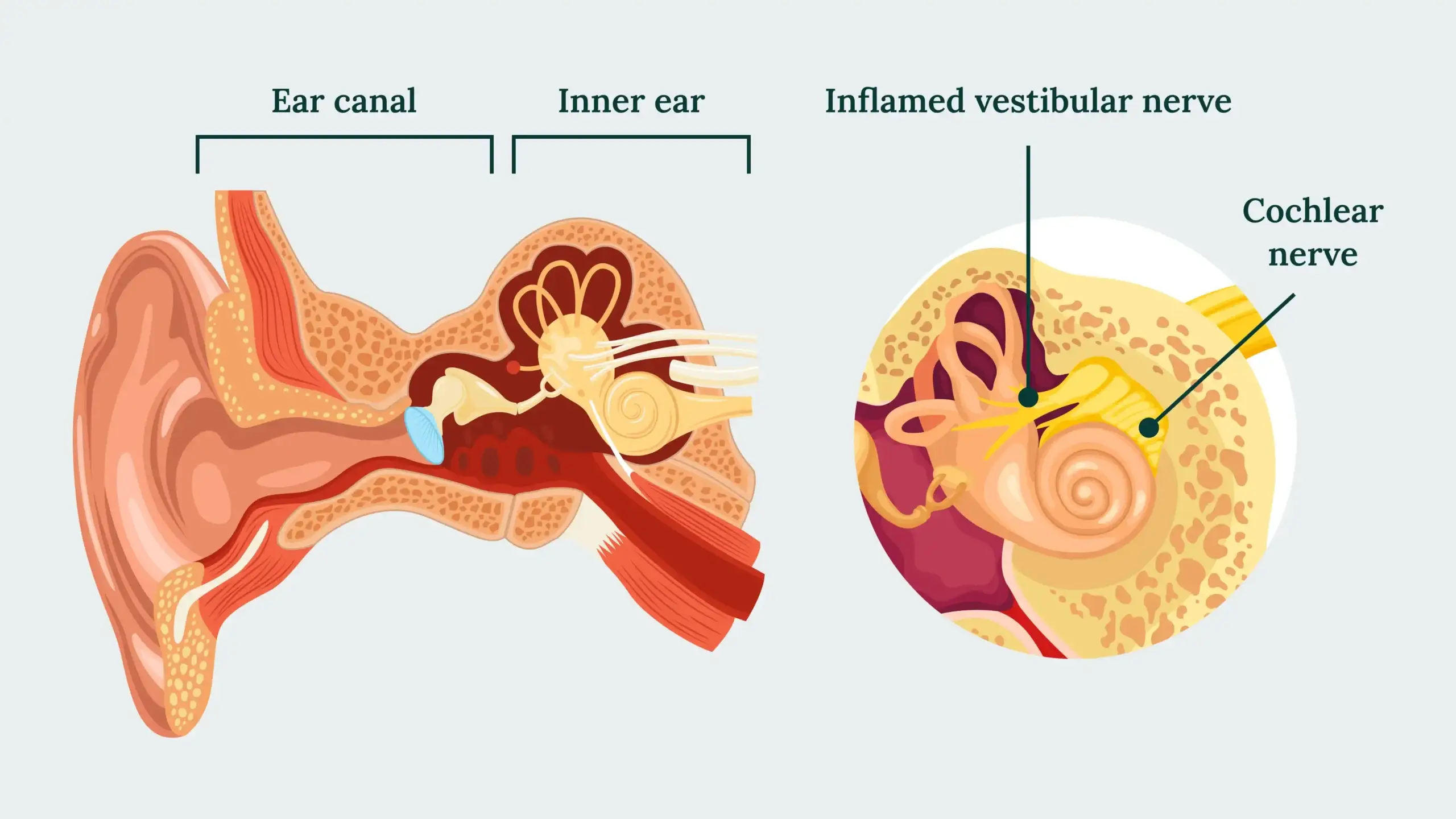
The episodes are thought to come from irritation of the vestibular nerve, the nerve that carries balance signals from your inner ear to your brain. A potential cause is a nearby blood vessel pressing on the nerve, a situation known as neurovascular cross-compression.2
Because attacks are so short, tests taken between attacks can look normal. This is one reason the condition is often overlooked. Recognising the typical pattern of frequent, brief spells is central to making the diagnosis.1
Vestibular paroxysmia can affect adults of any age, and it can develop gradually or appear quite suddenly. For some people, it is a mild nuisance, while for others, the unpredictable attacks affect confidence, work and sleep. The good news is that, once recognised, it is one of the more treatable causes of recurrent vertigo.
Vestibular paroxysmia symptoms
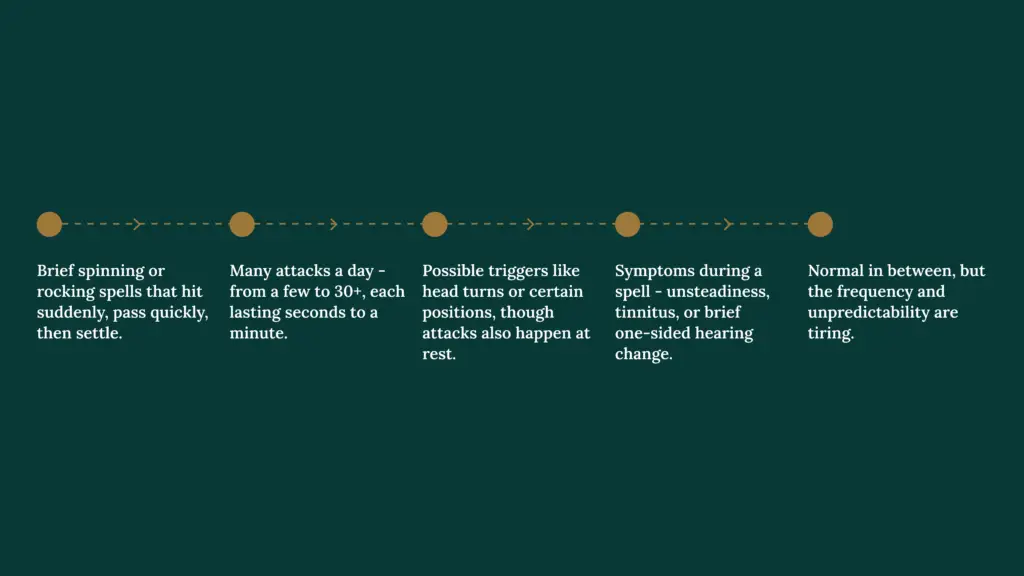
The hallmark of vestibular paroxysmia is short, recurrent attacks of vertigo or unsteadiness that start and stop suddenly.1
The most common features are:
- Brief spinning or swaying attacks, usually lasting a few seconds to a minute
- Frequent episodes, sometimes many times a day or more
- Attacks that may come on at rest or be triggered by a particular head position or by turning the head
- Unsteadiness or a feeling of imbalance during the attack
- Ringing or other noise in one ear (tinnitus), or a brief change in hearing during some attacks
- Symptoms that respond well to a specific type of medicine, which can support the diagnosis
The attacks are often described as stereotyped, meaning they feel much the same each time. Many people can carry on with daily life between episodes, although the unpredictability can be unsettling.
It can help to keep a simple diary of your attacks before an appointment. Noting how long each episode lasts, how often they happen, what you were doing at the time and whether you noticed any hearing change gives your clinician valuable information and can speed up the diagnosis.
Symptoms that need urgent assessment
Vestibular paroxysmia itself is not dangerous, but some symptoms that occur with dizziness need prompt medical attention. The NHS advises calling 999 or going to A&E if vertigo occurs with double vision or loss of vision, hearing loss, trouble speaking, or weakness, numbness or tingling in an arm or leg.3
You should also seek an urgent GP appointment or NHS 111 advice if you have vertigo with a severe headache, repeated vomiting, or a high temperature.3 These features are not typical of vestibular paroxysmia and point to causes that need checking first.
What causes vestibular paroxysmia?
In some people, vestibular paroxysmia is caused by a blood vessel lying against the vestibular nerve. The pulsing contact is thought to irritate the nerve and make it fire abnormally, which produces the brief bursts of vertigo.2
This neurovascular cross-compression is common on brain scans in people without symptoms too, so the scan alone does not confirm the diagnosis. Your clinician will weigh the scan findings alongside your history and your response to treatment.1
Less commonly, nerve irritation can follow other processes affecting the nerve, and in some people, no clear structural cause is found. When this happens, it does not mean the symptoms are imagined or that nothing can be done. It simply means the focus moves to managing the attacks and ruling out other causes.
Stress and tiredness do not cause vestibular paroxysmia, although, as with many conditions, they can make you more aware of symptoms. Treating any anxiety that has built up around the attacks can still be a helpful part of your overall care.
Diagnosing vestibular paroxysmia: what to expect
There is no single test that confirms vestibular paroxysmia. The diagnosis is built from your history, an examination, targeted balance and hearing tests, a scan where needed, and sometimes your response to treatment. An audiovestibular medicine specialist usually leads this process.1
Clinical history and examination
Your consultant will ask about the length, frequency and triggers of your attacks, and about any tinnitus, hearing change or other symptoms. The pattern of very short, frequent, similar episodes is the most useful clue.
An international expert group, the Bárány Society, has published criteria that help clinicians recognise vestibular paroxysmia in a consistent way.1 Your consultant will assess how well your symptoms fit this picture and how confident the diagnosis can be.
Tests and scans
Depending on your presentation, your consultant may arrange:
- Hearing tests, to check for any change in hearing
- Balance (vestibular) function tests, to assess how your inner ear and balance nerve are working
- An MRI scan, to look at the vestibular nerve and nearby blood vessels and to exclude other causes
Your consultant will explain the reason for each test before it is arranged. A trial of a specific medicine is sometimes used as part of the assessment, because a clear response can support the diagnosis.1
Conditions that can feel similar
Several balance conditions can cause dizziness or vertigo, and telling them apart matters because the treatments differ. The length of each attack and what triggers it are often the most helpful clues.
Condition | Typical attack length | Common clues |
|---|---|---|
Vestibular paroxysmia | Seconds, rarely over a minute | Very frequent, brief, similar attacks; may respond to specific medicine |
Benign paroxysmal positional vertigo (BPPV) | Under a minute | Triggered by specific head movements, such as rolling over in bed |
Vestibular migraine | Minutes to hours | Often with headache and light or sound sensitivity |
Ménière’s disease | 20 minutes to hours | With fluctuating hearing loss, tinnitus and ear fullness |
Vestibular neuritis | Days | A single prolonged episode, often after a viral illness |
If your symptoms could fit more than one of these, your consultant will use your history, examination and tests to work out the most likely cause. It is also possible to have more than one balance condition at the same time, which is another reason a thorough assessment is worthwhile.
Vestibular paroxysmia treatment
Vestibular paroxysmia usually responds well to treatment, and the aim is to reduce how often the attacks happen and how severe they are. The right approach depends on your diagnosis, your other health conditions and how much the symptoms affect your daily life.
Medicines
The main treatment is a type of medicine that calms abnormal nerve firing. Carbamazepine and oxcarbazepine are the options most often described in the medical literature, usually at low doses, and many people notice a clear improvement.2
These are prescription-only medicines. They are not suitable for everyone; they can interact with other medicines, and they need monitoring, so they should only be started and reviewed by a qualified clinician after a full assessment. Your consultant will discuss the likely benefits and any side effects with you, and a good response to treatment can also help confirm the diagnosis.1
Conservative measures and rehabilitation
Alongside medication, simple steps can help you feel safer during attacks. The NHS suggests sitting down as soon as you feel dizzy, moving your head slowly, and getting out of bed gradually.3
Where unsteadiness persists between attacks, your consultant may suggest vestibular rehabilitation, a tailored programme of balance exercises delivered by a specialist physiotherapist. These exercises aim to help your brain adapt and to rebuild your confidence in everyday movement.
Surgery
Surgery is rarely needed. In a small number of severe cases that do not respond to medicines, a neurosurgical procedure to relieve the pressure on the nerve may be considered, but only after careful specialist review of the risks and benefits.2
Does vestibular paroxysmia go away?
For many people, attacks are well controlled once the right treatment is found, and symptoms can settle considerably.2 Some people are able to reduce or stop medication over time under their consultant’s guidance.
An earlier diagnosis usually means a clearer plan and less time spent worrying about unexplained attacks. Even when symptoms do not disappear completely, most people can expect meaningful improvement with appropriate management, and regular review allows your treatment to be adjusted as your symptoms change.
When should you see a specialist?
The NHS advises seeing a GP if you have vertigo that will not go away or that keeps coming back3. Because the attacks in vestibular paroxysmia are so brief and frequent, the pattern is easy to overlook, so specialist audiovestibular assessment can be helpful. Consider an assessment if:
- You have repeated, very brief attacks of vertigo, sometimes many times a day
- The attacks feel similar each time and start or stop suddenly
- You have been told nothing is wrong, but the episodes continue
- Your symptoms are affecting your confidence, work or daily life
If you are not sure what is causing your dizziness, a specialist review can clarify the diagnosis and your options. You can read more about our audiovestibular medicine service.
NHS ENT and balance services can assess vestibular paroxysmia, although waiting times vary by area. If you would prefer to be seen sooner, our team can arrange a private consultation with an audiovestibular consultant.
Frequently asked questions about vestibular paroxysmia
Is vestibular paroxysmia dangerous?
Does vestibular paroxysmia go away?
Attacks often settle once the right treatment is started, and some people can reduce their medication over time under specialist guidance.2 Even when it does not resolve completely, most people improve with appropriate management.
Is vestibular paroxysmia caused by stress or anxiety?
No. The condition is linked to irritation of the vestibular nerve, often by a nearby blood vessel.2 Stress and tiredness can make you more aware of symptoms, but they are not the underlying cause.
What does a vestibular paroxysmal attack feel like?
Most people describe a sudden, brief spinning or swaying sensation that lasts seconds and can happen many times a day.1 Some also notice brief tinnitus or a change in hearing during attacks.
Can you drive if you have vertigo?
If you drive and you have vertigo, the NHS advises that you must tell the DVLA.3 Your consultant can advise you on driving in relation to your individual symptoms and treatment.
How is vestibular paroxysmia different from BPPV?
Both cause short attacks, but BPPV is typically brought on by specific head movements, such as rolling over in bed, while vestibular paroxysmia attacks are more frequent and may occur at rest.1 You can read more about BPPV and vestibular migraine on our condition pages.
Book a vestibular paroxysmia assessment in London
At Harley Street Audiovestibular Clinic (Harley AVM), our consultants have extensive experience in assessing and managing vestibular paroxysmia and other causes of vertigo and unsteadiness. We see adults and children with complex hearing, tinnitus and balance problems from across London and the UK.
A first appointment usually includes a detailed history and examination, relevant hearing and balance tests where appropriate, and a clear written plan for any further investigations. You can contact us to arrange a consultation or find out more about our related tinnitus service.
References
- Strupp M, Lopez-Escamez JA, Kim JS, et al. Vestibular paroxysmia: Diagnostic criteria (Bárány Society consensus document). Journal of Vestibular Research. 2016;26(5-6):409-415. View on PubMed
- Brandt T, Strupp M, Dieterich M. Vestibular paroxysmia: a treatable neurovascular cross-compression syndrome. Journal of Neurology. 2016;263(Suppl 1):S90-S96. View on PubMed
- NHS. Vertigo. https://www.nhs.uk/conditions/vertigo/ (accessed June 2026).