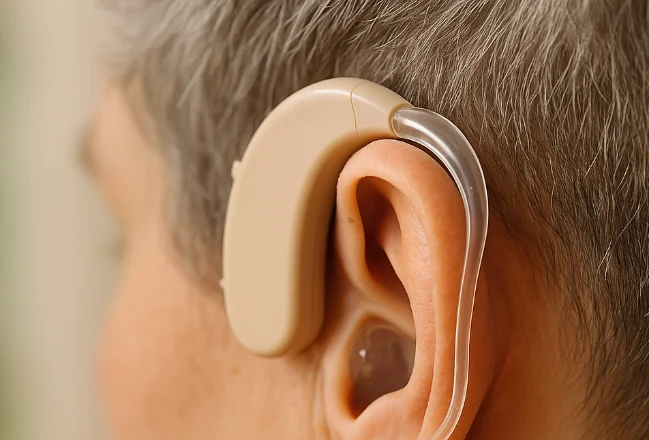
Ototoxicity is damage to the inner ear caused by a medicine or a chemical, and it can affect hearing, balance, or both.

Ototoxicity is damage to the inner ear caused by a medicine or a chemical. The word splits into oto, meaning ear, and toxicity, meaning poisoning. It is not an infection, and it is not an allergy. It is a direct toxic effect on the structures that turn sound and movement into signals your brain can read.
The part usually left out is balance. Your inner ear does two jobs. The cochlea hears. The vestibular system senses where your head is and how it is moving. A drug that reaches the inner ear can damage either one. Most people are told to listen out for ringing in the ears. Very few are told anything about dizziness or unsteadiness, so the balance version is often picked up late or put down to something else. This is part of why audiovestibular medicine exists as a distinct UK speciality: it treats hearing and balance as one system.
At Harley Street Audiovestibular Clinic, we assess both halves in the same visit, pairing hearing tests with vestibular function tests, because someone who has had gentamicin can have a normal audiogram and still have lost most of their balance function.
Key takeaways
- Ototoxicity is damage to the inner ear caused by a medicine or a chemical, and it can affect hearing, balance, or both.
- The balance side is the part most often missed. Gentamicin in particular can leave someone unsteady while their hearing test looks normal.
- Tinnitus and difficulty following speech in background noise are usually the first hearing signs, before any obvious drop in volume.
- Aminoglycoside antibiotics and cisplatin cause the most lasting damage. High-dose aspirin and quinine effects usually reverse once the dose comes down.
- A hearing test taken before treatment starts is what makes every later test meaningful, and it should cover the frequencies above 8 kHz.
- Never stop a prescribed medicine on your own. Report the symptom to the team who prescribed it and let them weigh the risks.
The two kinds of damage
Damage to hearing
The cochlea holds around 15,000 hair cells in each ear, each tuned to a pitch. High sounds are picked up at the base of the spiral. When a toxic drug reaches the cochlea, those base cells tend to go first, so early damage takes the highest pitches, and those carry consonants rather than volume. People rarely say sound has got quieter. They say speech has gone mushy, that they cannot follow a conversation in a busy restaurant, that the television needs subtitles now. Tinnitus often arrives at the same time, or just before.
Damage to balance
The vestibular system sits next to the cochlea and uses the same kind of hair cells. Damage here need not affect hearing at all, which is exactly why it gets missed. Ototoxic drugs usually affect both balance organs at once, so people do not tend to get classic spinning vertigo. They get something harder to describe: unsteadiness that is much worse in the dark or on soft ground, a feeling of walking on a boat, and a deep tiredness that comes from working at staying upright all day.
In humans, inner ear hair cells are not replaced once they are lost. That is why early detection matters far more here than with most side effects.
Symptoms to watch for
Symptoms depend on which half of the inner ear is affected. Many people get a mixture of both.
- Tinnitus: ringing, hissing or buzzing, often the first thing anyone notices.
- Difficulty following speech in background noise, before any obvious drop in volume.
- A sense that sound is muffled, distorted or tinny, or a feeling of fullness in the ear.
- Unsteadiness on your feet, especially in poor light or on uneven ground.
- Oscillopsia: the world appears to bounce or blur when you move your head or walk. This is the most disabling symptom of balance loss and one of the least discussed.
- Nausea and visual fatigue in busy environments such as supermarkets.
Timing varies by drug. High-dose aspirin can bring on tinnitus within hours, and it usually settles a day or two after stopping. Aminoglycoside and cisplatin damage builds over a course of treatment, and it can keep progressing for weeks or months after the last dose. A normal hearing test on the day treatment finishes does not close the question.
Which medicines can cause ototoxicity?
Several hundred substances have been linked to inner ear damage, but a small number cause most real cases. Being on one of them does not mean you will be affected. Most people are not.
- Aminoglycoside antibiotics: gentamicin, tobramycin, amikacin, streptomycin, neomycin. Gentamicin has a strong pull towards the balance organs, so it can leave someone unsteady with normal hearing. Risk rises with total dose, length of course and poor kidney function.
- Platinum chemotherapy: cisplatin mainly, with carboplatin carrying a lower risk at standard doses. Cisplatin damage is usually permanent and builds with each cycle.
- Loop diuretics: furosemide and bumetanide. Usually short-lived, and tied to how fast the drug is given into a vein. The bigger issue is pairing one with an aminoglycoside or cisplatin.
- High-dose aspirin and quinine: both cause tinnitus and hearing changes that nearly always reverse once the dose comes down.
- Aminoglycoside ear drops on a perforated eardrum, where the drug can reach the inner ear directly. UK practice is to choose a different drop where a hole is known or suspected.
Who is most at risk
Two people can have the same course of the same drug and end up in completely different places. Total cumulative dose and treatment length are the strongest predictors. Reduced kidney function matters because the kidneys clear the drug. Very young children and older adults are more vulnerable, and so is anyone with pre-existing hearing loss, ongoing noise exposure, or more than one ototoxic drug at a time.
Genetics matter too. Around 1 in 500 people carry a change in the mitochondrial gene MT-RNR1, usually the m.1555A>G variant. In someone who carries it, a single standard dose of gentamicin can cause severe, permanent deafness in both ears. Not a high dose, not a long course, one dose. Mitochondria are inherited from your mother, so deafness after antibiotics on your mother’s side is a real signal. A rapid cheek-swab test now gives a result in about half an hour, and NICE has backed its use in newborns while more evidence is gathered. If this runs in your family, say so before anyone is treated.
Monitoring: why the baseline test matters
A hearing test taken before treatment starts is what makes every later test mean something. Without it, a test six months on gives you a number and nothing to compare it against, and you cannot separate drug damage from age-related change or a loss that was always there.
Good monitoring includes extended high-frequency audiometry, which tests above the usual 8 kHz ceiling. Ototoxic damage shows up there first, often long before it reaches the pitches used for speech. Clinicians judge change against set criteria rather than by eye: a drop of 20 dB at one frequency, or 10 dB at two neighbouring frequencies, confirmed on a repeat test, should trigger a conversation about dose, drug choice or closer monitoring.
If you are about to start a known ototoxic drug, ask directly. Will I have a baseline hearing test? How often will it be repeated? Will it cover the high frequencies? Good children’s cancer and cystic fibrosis services do this as standard. Elsewhere it is patchy, and asking is what makes it happen.
Wondering whether ototoxicity monitoring applies to you?
We run baseline and follow-up ototoxicity testing day to day, covering pure tone audiometry with the extended high frequencies, tympanometry, otoacoustic emissions and the full vestibular battery in a single appointment. Our senior audiologists carry out testing and report with the consultant, so you leave with a written report you can hand straight to the team managing your treatment. If you would like that assessment for your own situation, you can get in touch with our team or read more about our vestibular function tests.
Prevention and otoprotection
Nothing brings back lost hair cells, so everything useful happens before or during treatment. The proven measures are unglamorous, but they work: the lowest effective dose for the shortest course, blood drug level checks, kidney function monitoring, avoiding two ototoxic drugs together where there is an alternative, avoiding loud noise during and shortly after a course, and hearing tests before and during treatment.
For one group, this has moved beyond theory. Anhydrous sodium thiosulfate is licensed to prevent cisplatin hearing loss in children and young people aged one month to under 18 with a solid tumour that has not spread, and NICE recommended it for the NHS in January 2025. In the trial evidence behind that decision, far fewer children lost any hearing when they had it, though it does not remove the risk altogether. Other antioxidants have been studied, but the evidence is not yet strong enough for routine use, and none should be taken alongside chemotherapy without oncology approval.
Treatment and rehabilitation
No treatment reverses ototoxic damage once it has happened. What does exist, and there is a lot of it, is rehabilitation that restores function.
Hearing aids are the mainstay for mild to severe loss, and because ototoxic loss sits in the high pitches, fitting focuses on consonant clarity rather than volume. Where loss is severe, and aids give too little benefit, a cochlear implant may be assessed at a specialist implant centre. Tinnitus is common after ototoxic damage and responds to treatment in a real sense: the sound usually stays, but the distress and intrusion can be reduced a long way through sound therapy, hearing aids, talking therapies and structured tinnitus management.
Vestibular rehabilitation is the treatment for lasting balance damage, and few people outside specialist services have heard of it. It is a supervised set of eye, head and body exercises that train the brain to lean more on vision and on feeling from the feet and joints. Progress is measured in months, and symptoms often flare in the early weeks, which is expected rather than a sign something is wrong. Where testing shows loss on both sides, the results are what a physiotherapist uses to set the starting point and judge progress against something objective.
Will it get better?
The honest answer turns almost entirely on which substance caused it. Changes from high-dose aspirin, quinine, and often loop diuretics usually settle within hours to a few days of the dose coming down. Damage from aminoglycoside antibiotics and cisplatin is usually permanent, and it can keep getting worse for weeks or months after the last dose, which is why follow-up testing matters.
Permanent is not the same as untreatable. People who have lost both balance organs often return to work and to things they had written off, though this is a learned skill rather than a repair, so it can slip in poor light or when you are unwell. No one can predict your recovery from a general guide. That needs your audiogram, your treatment history, and a clinician who has both in front of them.
Noticed a change in your hearing or balance during treatment?
Our consultants in audiovestibular medicine assess adults and children with suspected medicine-related hearing and balance changes, always alongside the team managing your treatment rather than in place of it. Every case is reported back to your GP and treating team, so the findings reach the people making decisions about your medication. If you would like that assessment for your own situation, you can get in touch with our team or read more about our approach to audiovestibular medicine.
FAQ
What are the first signs of ototoxicity?
Tinnitus is usually the first thing people notice, followed by trouble following speech in background noise before any clear drop in volume. If the balance organs are affected instead, the first signs are unsteadiness in the dark and a sense that the world bounces slightly when you walk.
Is ototoxicity permanent?
It depends on the substance. Changes from high-dose aspirin, quinine, and often loop diuretics settle within days of stopping. Damage from aminoglycoside antibiotics and cisplatin is usually permanent, because the inner ear hair cells are destroyed and in humans they do not grow back.
Can ototoxicity affect balance and not hearing?
Yes, and this is often missed. Gentamicin tends to damage the balance organs more than the cochlea, so someone can be left unsteady with a perfectly normal hearing test. This is why vestibular function testing matters where gentamicin has been given.
Should I stop taking a medicine if I get tinnitus?
No. Contact the team who prescribed it and describe the symptom. These medicines treat serious illness, and whether to change the dose, switch drug or continue with monitoring is a clinical decision that weighs the risk to your ears against the risk of the illness itself.
What is an ototoxicity hearing test?
It is a hearing test done before treatment and repeated during and after it. It should include extended high-frequency audiometry above 8 kHz, where ototoxic damage shows up first, and often otoacoustic emissions too. A set change from your baseline triggers a clinical review.
Who should I see about suspected ototoxicity in the UK?
If you are on treatment, speak to the team prescribing it first. Otherwise, start with your GP, who can refer you to audiology. Balance symptoms are best seen by audiovestibular medicine or a specialist balance clinic. Sudden hearing loss is urgent and should be seen within days.
References
- NHS, Hearing loss – https://www.nhs.uk/conditions/hearing-loss/
- NICE TA1034, Anhydrous sodium thiosulfate for preventing hearing loss caused by cisplatin chemotherapy – https://www.nice.org.uk/guidance/ta1034
- NICE HTE6, Genedrive MT-RNR1 ID Kit for detecting a genetic variant to guide antibiotic use in newborns – https://www.nice.org.uk/guidance/hte6
- Ganesan P et al., Ototoxicity: A Challenge in Diagnosis and Treatment, Journal of Audiology and Otology – https://pmc.ncbi.nlm.nih.gov/articles/PMC5894487/
- Brock PR et al., Sodium Thiosulfate for Protection from Cisplatin-Induced Hearing Loss, New England Journal of Medicine – https://www.nejm.org/doi/full/10.1056/NEJMoa1801109
- MHRA, Yellow Card scheme – https://yellowcard.mhra.gov.uk/
- RNID, Hearing loss information and support – https://rnid.org.uk/