
This post explains what middle ear myoclonus is, what causes it, what the symptoms feel like, and what treatment options are available. It is not a substitute for personalised medical advice.

That clicking, thumping, or fluttering in your ear is real. It has a name. And if you have spent months being told your ears look fine, you are not alone in that experience.
Middle ear myoclonus (MEM) is a recognised cause of rhythmic ear noise. But it is also genuinely underdiagnosed, and most people see several clinicians before anyone identifies it correctly.1
What is middle ear myoclonus?
Middle ear myoclonus is an involuntary, repetitive twitching of one or both of the two tiny muscles inside your middle ear. The result is a sound you can hear, usually clicking, thumping, or fluttering. It has a mechanical cause rather than a neurological one.1
The two muscles involved are the tensor tympani, which attaches to the malleus (the small hammer-shaped bone), and the stapedius, which attaches to the stapes (the stirrup-shaped bone). When either contract rhythmically without a clear trigger, it produces the sounds associated with MEM. Usually clicking, thumping, or fluttering. You hear it; the person next to you typically cannot.
Unlike most tinnitus, which is subjective (heard only by the person affected), MEM can occasionally be detected by an examiner. That is what makes it a form of objective tinnitus: the sound has a physical source that, in some cases, can be measured.2
The condition can affect one ear or both. It may arrive in brief bursts or run almost continuously. For some people, it is a mild nuisance. For others, it disrupts sleep, concentration, and daily life significantly.
Middle ear myoclonus symptoms
The defining feature of middle ear myoclonus is a rhythmic sound or sensation in the ear that comes in bursts, is not continuous, and does not beat in time with the pulse.1 The most common descriptions are:
- Rapid clicking, tapping, or thumping in one or both ears, often rhythmic and occurring in bursts
- A fluttering sensation inside the ear, sometimes described as a moth or butterfly trapped inside
- A low rumbling or muffled drumming, typically in short episodes rather than continuously
- A sound that is occasionally audible to people nearby in a very quiet room
- Episodes that start and stop without warning, sometimes lasting seconds, sometimes minutes
- Symptoms that worsen with stress, fatigue, caffeine, or in quiet environments
- A mild sense of fullness or pressure in the ear, in some cases
Pain is not a typical feature.3 If you have significant ear pain, sudden hearing loss, facial weakness, or new dizziness alongside the sounds, seek assessment promptly rather than waiting.
Tensor tympani myoclonus versus stapedial myoclonus
There are two main subtypes of middle ear myoclonus, each involving a different muscle and producing a slightly different sound.1 Identifying which muscle is involved matters because it guides both the diagnosis and the treatment approach.
Tensor tympani myoclonus
Tensor tympani myoclonus tends to produce a low-pitched rumbling or clicking. The tensor tympani muscle is supplied by the trigeminal nerve, so symptoms often worsen with stress, jaw problems such as temporomandibular joint (TMJ) dysfunction, or hyperacusis (sound sensitivity). Some people notice it starting after a period of anxiety or following a head injury.
This is the more common of the two subtypes in clinical practice.1 It is also more closely linked to conditions that can be addressed conservatively, such as jaw treatment, stress management, and sound therapy.
Stapedial myoclonus
Stapedial myoclonus tends to produce a higher-pitched clicking and is caused by involuntary contractions of the stapedius muscle, which is supplied by the facial nerve.4 Because of this nerve supply, stapedial myoclonus is sometimes associated with conditions that affect the facial nerve directly: Bell’s palsy, herpes zoster affecting the ear (Ramsay Hunt syndrome), or surgical or viral facial nerve injury.
In our clinic, stapedial myoclonus is less common than tensor tympani involvement, but it is more frequently associated with a specific identifiable cause. When the facial nerve has been affected by infection or injury, stapedial myoclonus can appear during recovery as the nerve regenerates. In these cases, the prognosis often depends on the degree of facial nerve recovery rather than on middle ear treatment alone.
Stapedial myoclonus can sometimes be detected on specialist middle ear testing. Acoustic reflex testing and tympanometry occasionally capture the muscle contractions directly,1 which can help confirm the diagnosis and distinguish it from tensor tympani involvement.
In practice, the two subtypes can be difficult to distinguish from the description alone. Specialist testing is usually needed to confirm which muscle is involved and to guide the most appropriate management.
What causes middle ear myoclonus?
In many cases, no single cause is found. A 2012 review in Otology and Neurotology found that middle ear myoclonus frequently occurs with no identifiable underlying pathology.1 That does not mean the condition is untreatable. It means the focus of the assessment shifts to ruling out the causes that do need treatment.
Known contributing factors include:
- Neurological conditions such as multiple sclerosis
- Facial nerve pathology: Bell’s palsy, herpes zoster (Ramsay Hunt syndrome), or facial nerve compression4
- Stress, anxiety, and fatigue, which increase neuromuscular excitability throughout the body, including in the middle ear muscles
- Upper respiratory tract infections or ear infections, which can irritate the nerves supplying the middle ear muscles
- Eustachian tube dysfunction, where pressure changes in the middle ear trigger reflex muscle activity
- Head injury or acoustic trauma from exposure to sudden or sustained loud noise
- Temporomandibular joint (TMJ) dysfunction or trigeminal nerve sensitisation
- Hyperacusis (sound sensitivity), which may sensitise the middle ear’s protective reflex over time
One of the most common situations we see in the clinic is a patient who has been told their symptoms are anxiety-related before anyone has tested the middle ear muscles. Anxiety can make MEM worse. It does not cause it. The muscle contractions are real and physical, and they need a different assessment from stress-related tinnitus. If your tinnitus is rhythmic, clicking, and comes in bursts rather than as a continuous tone, it is worth asking specifically about middle ear myoclonus before accepting a purely psychological explanation.
Diagnosing middle ear myoclonus: what to expect
There is no single test that confirms middle ear myoclonus.1 Diagnosis is built from your clinical history, the character of the sound you are hearing, and a set of targeted investigations. A specialist in audiovestibular medicine leads this process.
Clinical history and examination
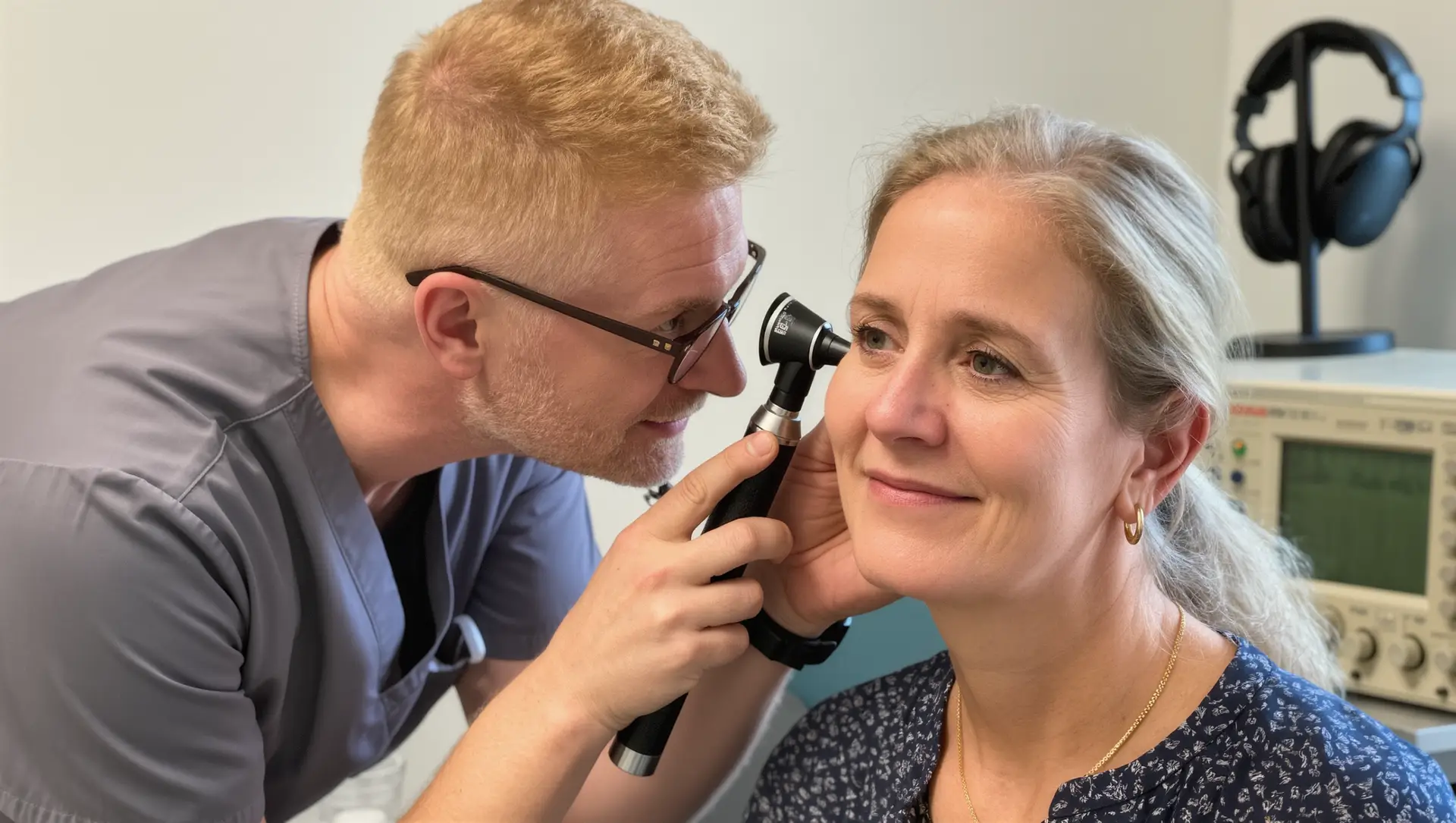
Your medical consultant will want to know exactly what the sound is like: its rhythm, pitch, whether anything triggers or stops it, and how long episodes last. They will also ask about your hearing, any history of ear infections, facial nerve problems, head or neck injury, jaw problems, and coexisting conditions.
Examination of your ear canals and eardrums comes next. Combined with an assessment of the jaw and surrounding structures, this helps identify visible causes and guides testing.
Specialist investigations
Depending on your presentation, the following tests may be arranged:
- Pure tone audiometry: to assess your hearing across a range of frequencies
- Tympanometry: a quick, painless test that measures how your eardrum moves in response to small changes in air pressure; in some cases, this can detect middle ear muscle contractions directly
- Acoustic reflex testing: assesses the stapedius reflex and helps distinguish MEM subtypes
- Otoacoustic emissions (OAE): measure sounds produced by your inner ear, or cochlea (the fluid-filled structure that converts sound into nerve signals), to help rule out other causes2
- Stapedial Reflex Decay: An extension of the acoustic reflex testing where a loud noise can provoke middle ear muscle contraction and the classic pattern of middle ear myoclonus can be identified.
- Eustachian Tube Function tests: Objective tests of eustachian tube and middle ear function – where dysfunction can lead to abnormally contracting middle ear muscles or ear drum.
- MRI scanning: to exclude vascular abnormalities or structural causes, particularly in complex or atypical presentations
Your consultant will decide which investigations are needed based on your specific clinical picture.
What else can cause similar symptoms?
Several conditions produce rhythmic ear sounds. Your clinician will want to exclude these before confirming a diagnosis of middle ear myoclonus. The character of the sound is often the most useful clue.
- Pulsatile tinnitus: a rhythmic whooshing or thumping that matches the heartbeat, caused by blood flow near the ear. If your sound beats in time with your pulse, pulsatile tinnitus is the more likely diagnosis
- Tensor tympani syndrome (TTS): the tensor tympani muscle is overactive and reactive to sound or stress, but does not contract in the same repetitive myoclonic pattern seen in MEM
- Palatal myoclonus: rhythmic contractions of the soft palate muscles that transmit sound to the ear, usually described as a clicking heard inside the head
- Patulous Eustachian tube: the Eustachian tube stays open when it should close, causing echoing of your own breathing or voice inside the ear
- Vascular anomalies: such as a high-riding or dehiscent jugular bulb, or superior semicircular canal dehiscence (a thinning of bone over the inner ear)
If the sound matches your heartbeat, pulsatile tinnitus needs to be investigated first. If it occurs with breathing or changes when you swallow, a patulous Eustachian tube maybe the cause. If it comes in rapid bursts unrelated to either and worsens with stress or noise, middle ear myoclonus is a possible diagnosis.
Middle ear myoclonus treatment
There is no single treatment that works for everyone, and the right approach depends on which muscle is involved, whether an underlying cause has been identified, and how much the symptoms are affecting daily life. Most people improve with a combination of conservative measures and targeted management.
Conservative management
For many people, particularly those with mild or infrequent symptoms, conservative measures provide meaningful relief:
- Stress management: breathing exercises, progressive muscle relaxation, and mindfulness reduce neuromuscular excitability in the middle ear
- Addressing sleep difficulties, since fatigue consistently worsens MEM episodes
- Reducing caffeine and alcohol intake, both of which can aggravate neuromuscular irritability
- Sound enrichment: low-level background sound (a fan, soft music, or a white noise machine at night) reduces the salience of the clicking or thumping when the room is quiet
- Treatment of any identified underlying cause: ear infections, jaw problems, or Eustachian tube dysfunction
Medical options
Where conservative approaches are not sufficient, a clinician may consider pharmacological options. Muscle relaxants or anticonvulsants are sometimes used in cases where conservative management has not helped.1 These are prescription-only medicines and require a full clinical assessment before they are recommended.
Published case reports describe botulinum toxin as an experimental intervention in highly selected, treatment-resistant cases, typically within specialist research settings. This is not a routinely offered treatment. Evidence remains limited to small case series.1
Surgical treatment: tenotomy
In severe, persistent cases that have not responded to conservative and medical approaches, a procedure called a tenotomy may be considered although it is not commonly recommended. This involves cutting the tendon of the affected muscle (the tensor tympani, the stapedius, or both) to stop the involuntary contractions.
As with any surgical procedure, there are risks, including changes to hearing and middle ear function. Tenotomy is only considered when other approaches have failed, and symptoms are meaningfully affecting quality of life. It would involve your audiovestibular consultant working in close conjunction with their ENT surgeon colleagues.
Does middle ear myoclonus go away on its own?
Sometimes, yes. When MEM is triggered by something temporary, such as an ear infection, a period of acute stress, or a noise exposure event, it often settles once the trigger resolves. Nothing else is needed.
For others, particularly when no specific cause is found, symptoms can persist for months or years. This does not mean nothing can be done. Most people who receive an accurate diagnosis and appropriate management see meaningful improvement, even when complete resolution is not achievable.
Getting a diagnosis early matters. It allows your clinician to rule out anything that does need treatment, give you accurate information about what to expect, and start a management plan before the symptoms become entrenched.

When should you see a specialist?
Current UK guidance recommends that any persistent, unexplained rhythmic ear noise should be reviewed by a clinician,3 and one-sided symptoms warrant specialist assessment. Consider a specialist audiovestibular assessment if any of the following apply:
- Clicking, fluttering, or thumping in your ear is frequent, persistent, or getting worse
- The sound is audible to people around you
- Symptoms started after a head injury, ear infection, or surgery
- You have been told that nothing is wrong, but symptoms continue
- Symptoms are affecting your sleep, concentration, or mental well-being
- You have new changes to your hearing, new dizziness, facial weakness, or ear pain alongside the sounds
NHS ENT services can assess middle ear myoclonus. In practice, waiting times vary significantly by region, and many areas currently have ENT waits of 18 weeks or more. If you would prefer to be seen more quickly, our team at Harley Street Audiovestibular Clinic sees patients privately. We can help you arrange an initial consultation with one of our audio vestibular consultants, which will include reviewing your clinical history and examination. Any further investigations are arranged separately, and your consultant will explain the reason for each one before it is booked.
Frequently asked questions about middle ear myoclonus
Is middle ear myoclonus dangerous?
In the vast majority of cases, middle ear myoclonus is not caused by anything dangerous.1 It does not damage your hearing, and it is not a sign of a brain tumour or stroke. In a small number of cases, it can be associated with conditions that warrant further investigation, such as facial nerve pathology or neurological disease. A specialist assessment is the safest way to confirm the diagnosis and exclude anything that needs treating.
Does middle ear myoclonus go away?
It depends on the underlying cause. When MEM is triggered by something temporary, such as an ear infection or a period of acute stress, it often settles once the trigger resolves. In other cases, particularly idiopathic MEM where no cause is found, symptoms can persist and may need active management. Many people see significant improvement with the right approach.
Can middle ear myoclonus be caused by anxiety?
Anxiety and stress are among the most commonly reported triggers, and they can worsen or prolong episodes. The muscle contractions are real and mechanical, not imagined or psychosomatic. Managing stress and anxiety is often an important part of the treatment plan, but it is not the whole answer. If a clinician has attributed your symptoms entirely to anxiety without examining the middle ear muscles, a second opinion from an audiovestibular specialist is worth considering.
What does middle ear myoclonus sound like?
People describe it in different ways. Rapid clicking or tapping, sometimes compared to Morse code or a typewriter. A low thumping or drumming. A fluttering like a butterfly in the ear. A muffled rumbling. The sound is usually rhythmic, comes in bursts, and does not beat in time with your heartbeat. That is what separates it from pulsatile tinnitus.
Is there an NHS pathway for middle ear myoclonus?
Yes. Middle ear myoclonus can be assessed through NHS ENT or audiovestibular medicine services.3 Waiting times vary by area. If your GP has not identified the cause of your ear sounds, asking for a referral to a consultant in audiovestibular medicine is a reasonable next step. Private specialist clinics can generally offer faster access to a medical consultant-led assessment if the wait is a concern.
How is middle ear myoclonus different from tensor tympani syndrome?
Tensor tympani syndrome (TTS) refers specifically to an overactive tensor tympani muscle that reacts to sound, stress, or the anticipation of sound, but does not contract in the same involuntary repetitive pattern seen in middle ear myoclonus.1 MEM is the broader term covering rhythmic, involuntary contractions of either the tensor tympani or the stapedius. There is clinical overlap between the two, and a specialist assessment is usually needed to distinguish them.
Book a middle ear myoclonus assessment in London
At Harley Street Audiovestibular Clinic (Harley AVM), our consultants have extensive experience in assessing and managing middle ear myoclonus, stapedial myoclonus, and tensor tympani syndrome. We see adults and children with complex hearing, tinnitus, and balance problems from across London and the UK.
A first appointment typically includes a detailed clinical history and examination, core hearing and middle ear tests on the same visit where appropriate, and a clear written plan for any further investigations. You can contact us to arrange a consultation or find out more about our middle ear myoclonus service.
References
- Bhimrao SK, Masterson L, Baguley D. Overview of management of middle ear myoclonus. Otology and Neurotology. 2012;33(5):691-694. View journal abstract
- Bance M, et al. An overview of objective tinnitus. In: Snow JB, ed. Tinnitus: Theory and Management. Hamilton, ON: BC Decker; 2004. View on Google Books
- NICE Clinical Knowledge Summary: Tinnitus. cks.nice.org.uk/topics/tinnitus
- Oliveira CA. Tensor tympani muscle myoclonus following stapedectomy. Laryngoscope. 1997;107(7):978-980. PubMed PMID 9217088