
A fluttering, thumping or blocked sensation deep in one ear, often with pain or a new sensitivity to everyday sound, can be a sign of tonic tensor tympani syndrome. This guide explains its symptoms and causes, how it differs from tensor tympani myoclonus, and how it is assessed in the UK alongside the conditions it so often travels with, tinnitus and hyperacusis.

Key takeaways
- Tonic tensor tympani syndrome (TTTS) describes a lowered contraction threshold in a tiny middle ear muscle, thought to produce ear pain, fullness, fluttering and sound sensitivity.
- It is closely linked with tinnitus and, in particular, with hyperacusis, and is often set off by an acoustic incident such as a sudden loud sound through a headset.
- TTTS is not the same as tensor tympani myoclonus. Myoclonus tends to cause an audible clicking; the tonic picture is a sustained contraction with a wider symptom cluster.
- TTTS remains a proposed, debated model rather than a firmly established diagnosis, so a good assessment is as much about ruling other causes out as ruling TTTS in.
- Most people improve with conservative care: reassurance, sound therapy, and managing stress and any related jaw or tinnitus problems. Medication and surgery are rare and specialist-led.
- Sudden hearing loss, severe one-sided symptoms or any neurological signs are not typical of TTTS and need prompt medical review.
Have you felt a fluttering, thumping or blocked sensation deep in one ear? Perhaps with pain, or a sudden dislike of ordinary sounds? You may have come across the term tonic tensor tympani syndrome. It points to a tiny muscle in the middle ear called the tensor tympani. The idea is simple: in some people, this muscle becomes too quick to tighten, and it stays tight for too long.
One point clears up most of the confusion online. Two different problems share similar names. Tensor tympani myoclonus means brief, involuntary muscle twitches. These often produce a rhythmic clicking that a clinician can sometimes hear. Tonic tensor tympani syndrome (TTTS) is different. Here the muscle stays contracted, the trigger threshold is low, and the symptoms are broader. It is usually discussed alongside tinnitus and hyperacusis. The two overlap, but they are not the same thing. Treating them as one is the most common error in patient information on this topic.
What the tensor tympani muscle actually does
The tensor tympani is one of two tiny muscles in the middle ear. The middle ear is the small, air-filled space behind the eardrum. The muscle runs forward from near the base of the skull. It attaches to the malleus, the first of the three small hearing bones (the ossicles). The malleus joins the eardrum on one side. On the other hand, the two remaining bones link to the inner ear.
When the tensor tympani contracts, it pulls the malleus inward and stiffens the eardrum. That stiffening softens the loud, low-pitched sound as it passes through the bones. This is why the muscle is often called part of the ear’s own volume control. It also helps with the startle response and with the eustachian tube, the channel that ventilates the middle ear.
One anatomical detail explains a lot of the symptoms. The tensor tympani is supplied by a branch of the trigeminal nerve, the same nerve that serves the jaw muscles and much of the face. That shared wiring is why TTTS symptoms can spread beyond the ear into the cheek, jaw and neck, and why jaw problems and ear problems so often travel together.
Symptoms of tonic tensor tympani syndrome
TTTS does not have one signature symptom. It presents as a cluster, and no two people report the same mix. The features described most consistently in the research and in the clinic are:
- A fluttering, tapping or thumping sensation in the ear, sometimes described as an insect wing or a tiny hammer.
- A feeling of fullness, pressure or blockage, as though the ear needs to pop but will not.
- Ear pain, or a dull ache, that can extend to the cheek, jaw or down the neck.
- Muffled or distorted hearing that comes and goes.
- A sudden sensitivity to everyday sounds (hyperacusis), where normal noise feels uncomfortably loud or sharp.
- Tinnitus: ringing, hissing or clicking with no external source.
- Numbness or a burning sensation in and around the ear.
- Mild dizziness or unsteadiness, and occasionally nausea or a light headache.
Symptoms often fluctuate. Many people notice they flare when they are tired, stressed, or bracing against noise, and settle during calmer periods. They may affect one ear or both. In the clinic, the flutter is often the symptom people mention first, yet it is the sound sensitivity that tends to affect daily life most.
The clicking question: is the sound audible to others?
This is where the two conditions separate. In tensor tympani myoclonus, the muscle twitch can be rhythmic and, in some cases, loud enough for a clinician to detect during an examination. That is an example of so-called objective tinnitus, meaning it has a physical source that another person can register. The tonic picture is different: the contraction is more sustained, and the dominant complaints are pressure, pain, fullness and sound sensitivity rather than an audible click. Knowing which pattern you fit helps steer the assessment and the treatment.
What causes it, and why does the ear overreact
The honest position is that the exact cause is not settled. The prevailing model is that the tensor tympani’s protective reflex becomes over-sensitive, so it fires too readily and holds on too long. Several things appear to lower that threshold.
An acoustic incident or acoustic shock
A sudden, unexpected loud sound that the brain reads as threatening can prime the reflex. This is well recognised in people who wear headsets, where a shriek or feedback tone down the line can trigger lasting symptoms. Acoustic shock of this kind is a genuine occupational issue for call-centre and contact-centre staff, and it is one of the clearest recognised triggers for the TTTS pattern.
Everyday movements and the startle response
Because the muscle is tied into chewing, swallowing, talking and being startled, symptoms can be provoked by these ordinary actions once the reflex is sensitised. Some people first notice the flutter while eating or yawning.
Stress, anxiety and a learned loop
Stress does not cause TTTS on its own, but it lowers the trigger threshold and helps keep symptoms going. A cycle can form: an unpleasant ear sensation raises anxiety, the heightened anxiety makes the reflex more twitchy, and the symptom returns. Recognising this loop is not about dismissing the problem as psychological. It is a practical route into treatment because the loop can be interrupted.
Jaw, eustachian tube and nerve factors
There is unclear evidence whether TTTS is linked to jaw problems such as temporomandibular disorder. The eustachian tube matters too. When it is not working well, often after colds, sinus trouble or hay fever, the middle ear system is disturbed. Irritation of the trigeminal nerve has also been reported alongside these symptoms.
The link with tinnitus and hyperacusis
TTTS is rarely discussed on its own. It accompanies tinnitus and, above all, hyperacusis. This link is not a guess. In the multi-clinic study that shaped the modern definition, symptoms consistent with TTTS were common in people attending with tinnitus. They were reported in a clear majority of those with significant hyperacusis.
The proposed explanation is intuitive. If the brain has become primed to treat sound as a threat, the tensor tympani, as a protective reflex, tends to fire more readily. Sound sensitivity and an overactive middle ear muscle then reinforce one another. This is also why the most effective treatments for TTTS are the same evidence-based approaches used for tinnitus and hyperacusis: they retrain that threat response rather than target the muscle directly.
Is tonic tensor tympani syndrome a recognised diagnosis?
TTTS is best understood as a proposed model, not a firmly established disease. Its existence and its boundaries are still debated among specialists, the supporting studies are limited in number, and some researchers have argued that the term should be retired in favour of describing the symptoms.
That uncertainty does not mean your symptoms are imagined. Ear pain, fullness, flutter and sound sensitivity are real and can be measured in their impact on daily life. In practice, a careful assessment is as much about excluding other explanations as it is about confirming TTTS, and that any clinician who presents TTTS as a cast-iron diagnosis with a guaranteed fix is overstating what is known.
How is it diagnosed
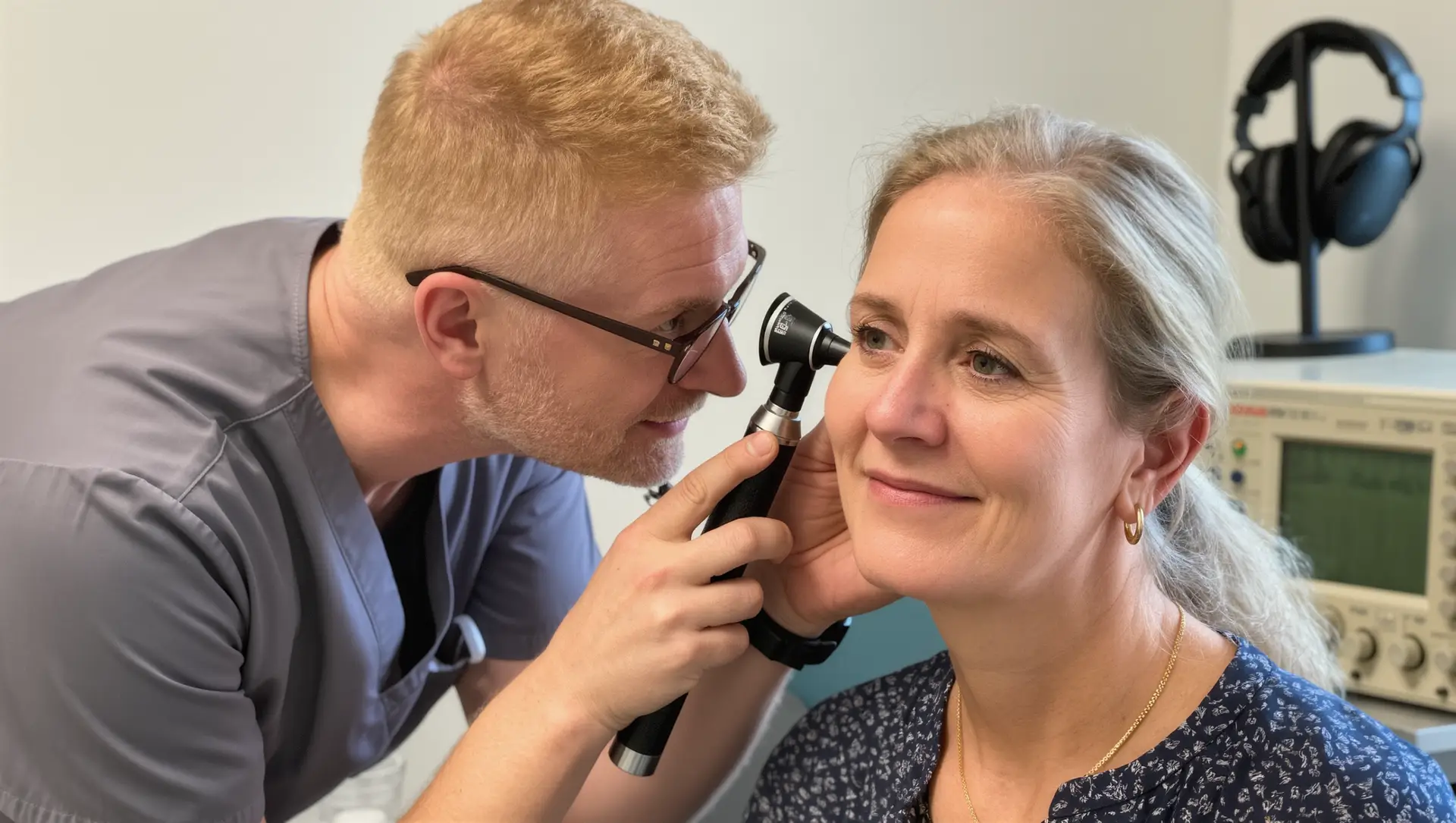
There is no single test that proves TTTS. The diagnosis is clinical. A specialist builds a picture from your history and examination. Hearing tests are used mainly to describe the problem and to rule out other causes. The right clinician is a consultant in audiovestibular medicine, the medical speciality dedicated to hearing and balance, or an audiologist working within that field. On the NHS, you may also be seen in an ear, nose and throat (ENT) department.
History and examination
Expect detailed questions about the character and timing of your symptoms, any triggering event such as a loud sound or a headset incident, your tinnitus and sound tolerance, and your jaw, sinus and stress history. On examining the ear, a clinician may occasionally see the eardrum making small rhythmic movements.
Hearing and middle ear tests
- Tympanometry measures how the eardrum and middle ear respond to pressure changes. It can sometimes capture the tell-tale flutter, though if the muscle is not contracting during the test, it may read as normal.
- Acoustic reflex testing looks at how the middle ear muscles respond to sound and can reveal an unusually sensitive or low-threshold reflex. Acoustic reflex decay can help to identify any patterns or flutter of your ear drums or middle ear bones.
- Otoacoustic Emissions (OAE) test for how well the inner ear hearing hair cells are working.
- Pure tone and speech audiometry map your hearing across pitches and check clarity, establishing whether there is any true hearing loss underlying the symptoms.
- Auditory brainstem response (ABR) tracks the nerve signal from the ear to the brainstem and helps exclude other causes when the picture is unclear.
Imaging with an MRI or CT scan is not routine, but it may be arranged to rule out other conditions when symptoms are one-sided, severe or accompanied by anything unusual.
What else could it be
The symptoms are non-specific, so a good work-up weighs the alternatives before settling on TTTS. Rhythmic clicking can come from palatal myoclonus, a twitch of the soft palate rather than the ear. A blocked eustachian tube, or an abnormally open one (a patulous eustachian tube), can cause the fullness and the sense of hearing yourself too loudly.
Tinnitus that beats in time with your heart points towards blood-vessel causes and is investigated differently. Conditions such as otosclerosis or Meniere’s disease may also need to be ruled out. Sorting between these is exactly why specialist assessment matters.
Unsure what is behind your ear symptoms?
Harley Street Audiovestibular Clinic is a consultant-led diagnostic clinic for hearing, tinnitus and balance problems. Tympanometry, acoustic reflex testing and audiometry can all be carried out in a single visit, so the conditions described above can be told apart with confidence.
Treatment: what actually helps
Most people with TTTS improve without any procedure. The mainstay is conservative management aimed at calming the overactive protective reflex and treating anything feeding it. Outcomes vary from person to person, and progress is usually gradual rather than instant.
Understanding and reassurance
This sounds modest but is genuinely part of the treatment. When people understand that the sensation is a misfiring protective reflex rather than a sign of damage, the fear that keeps the loop running tends to ease, and symptoms often soften with it.
Sound therapy and desensitisation
Structured sound therapy helps the hearing system relearn that ordinary sound is safe. It includes tinnitus retraining and a gentle, step-by-step return to sound for hyperacusis. Done properly, with professional guidance, this is one of the most effective routes. It tackles the sound sensitivity that drives the reflex head-on.
Relaxation, stress management and CBT
Because stress lowers the trigger threshold, techniques that dial down the nervous system help. Simple relaxation and breathing practice, good sleep, and, where appropriate, cognitive behavioural therapy (CBT) can all reduce both the frequency of flare-ups and the distress they cause.
Treating the underlying cause
Where a jaw disorder, dental problem or eustachian tube issue is contributing, treating that can settle the ear symptoms too. This may mean referral to a dentist, a maxillofacial specialist or a physiotherapist for the jaw, or management of allergies and congestion for the eustachian tube.
Medication
Medicines are not a first-line treatment. They are used sparingly, and only under specialist supervision. Muscle relaxants and some anti-seizure medicines have been tried. Botulinum toxin injection has been reported in stubborn cases. The evidence for all of these in TTTS is limited. Any decision to prescribe belongs with a clinician who can weigh the benefits against the risks for you. This article does not recommend any specific medicine.
Surgery
Surgery is a rare last resort and is not relevant to most people with TTTS. Where an audible middle ear myoclonus is severe and has failed every conservative measure, an operation to divide the tensor tympani tendon (and sometimes the stapedius tendon) has been described. It is reserved for a small minority, carries its own risks, and is a decision made only after specialist assessment.
A note on what to expect
No treatment can promise a fixed timeline or a guaranteed cure.
Improvement is real and common, but it tends to come from steady, layered management rather than a single quick fix.
What you can do yourself
Alongside professional care, a few practical habits support recovery:
- Resist the urge to over-protect your ears. It feels logical to wear earplugs constantly, but in hyperacusis, this usually backfires, making the ears even more sensitive over time. Save hearing protection for genuinely loud environments.
- Reintroduce ordinary sound gently. Calm background sound, rather than silence, helps the system recalibrate.
- Look after your jaw. If you clench or grind or notice jaw clicking, easing that tension can help the ear.
- Manage stress and sleep deliberately. These are not soft extras here: they directly influence how twitchy the reflex is.
- Keep a simple symptom diary. Noting what precedes a flare often reveals a pattern you can then act on.
Getting seen in the UK: your care pathway
If symptoms are persistent or troubling, the usual first step is to see your GP. They can examine your ears, check for treatable causes such as wax or infection, and refer you onward. On the NHS, that referral is typically to an ENT department or an audiology or audiovestibular service, though waiting times vary by area.
TTTS sits at the specialist end of ear medicine, and it often overlaps with tinnitus and hyperacusis. For that reason, some people choose to see a private audiovestibular clinic directly. The aim is usually to be seen sooner or to get a full set of tests in one appointment. Either route is reasonable. What matters is that whoever you see has real expertise in hearing, tinnitus and sound-tolerance problems, not ear health in general. That narrower focus is exactly what audiovestibular medicine, as a speciality, exists to provide.
Seeing a specialist privately: what to expect
A thorough private assessment should do more than take a single measurement. Expect a detailed history, an ear examination, and a set of hearing and middle ear tests. As a guide, tympanometry, acoustic reflex testing and audiometry are usually standard. Further tests, such as ABR, are added when needed. Fees differ between clinics and depend on how much testing is involved. It is fair to ask what the assessment includes and what it will cost before you book.
How to choose a clinic
- Look for clinicians who specialise specifically in audiovestibular medicine, tinnitus and hyperacusis.
- Check that the work-up includes middle ear and reflex testing, not just a basic hearing check.
- Favour a clinic that is candid about the uncertainty around TTTS and focuses on ruling out other causes, rather than one promising a guaranteed cure.
Will it go away? Outlook and living with TTTS
For many people, the picture is encouraging. Symptoms often ease with reassurance and conservative care. This is most true when a linked hyperacusis, tinnitus or jaw problem is treated at the same time. That said, TTTS can be stubborn, and it can come and go. There is no reliable way to predict an exact timeline. The best approach is to set realistic expectations and to treat steadily, rather than chase a single cure.
When to seek help sooner
TTTS itself is not dangerous, but some ear and hearing symptoms are not typical of it and should not be ignored. Seek prompt medical advice if you experience any of the following.
Get checked promptly if you have
- Sudden hearing loss, or a rapid drop in hearing, especially in one ear. This can be a medical emergency.
- Severe, worsening or one-sided ear pain, or any discharge from the ear.
- Tinnitus that pulses in time with your heartbeat.
- Dizziness with other neurological signs, such as facial weakness or numbness, double vision or difficulty speaking.
- Symptoms that follow a head injury.
Ready to have your symptoms properly assessed?
Our consultants in audiovestibular medicine assess tinnitus, hyperacusis and middle ear muscle problems, including TTTS, at 86 Harley Street in London. Care is diagnosis-led, and hearing therapy is available in-house when sound tolerance needs rebuilding. Contact us to arrange a consultation.
Frequently asked questions
What is tonic tensor tympani syndrome in simple terms?
It is a proposed condition in which a small middle ear muscle, the tensor tympani, becomes too quick to contract and stays contracted too long. This is thought to cause ear fluttering, fullness, pain and sensitivity to sound, and it is closely linked with tinnitus and hyperacusis.
Is tonic tensor tympani syndrome the same as tensor tympani myoclonus?
No. They overlap but differ. Myoclonus refers to brief muscle twitches that can produce an audible clicking. The tonic pattern is a more sustained contraction with a wider symptom cluster of pressure, pain and sound sensitivity, and it usually does not produce a click others can hear.
What does tensor tympani flutter feel like?
People often describe a rapid fluttering, tapping or thumping deep in the ear, sometimes likened to a butterfly wing or a tiny drum. It can come with a sense of fullness or pressure and may be set off by loud sound, chewing, swallowing or stress.
Can stress and anxiety cause tensor tympani symptoms?
Stress does not cause the condition by itself, but it lowers the threshold at which the reflex fires and helps keep symptoms going. A loop can form where the symptom raises anxiety and the anxiety worsens the symptom. This is one reason relaxation and stress management help.
How is tonic tensor tympani syndrome diagnosed?
There is no single definitive test. A specialist in audiovestibular medicine, or an ENT service, makes a clinical diagnosis from your history and examination, supported by hearing and middle ear tests such as tympanometry, acoustic reflex testing and audiometry, mainly to characterise the problem and exclude other causes.
Does tonic tensor tympani syndrome go away on its own?
It often improves with conservative treatment, especially when linked hyperacusis, tinnitus or jaw problems are treated too. It can also fluctuate and persist, and there is no reliable way to predict an exact timeline, so steady management usually works better than expecting an instant cure.
What is the best treatment for tonic tensor tympani syndrome?
For most people, it is conservative: understanding the mechanism, sound therapy and desensitisation, and managing stress, sometimes with CBT. Treating any underlying jaw or eustachian tube problem helps. Medication and surgery are rare, specialist-led options considered only when conservative care has not worked.
Which doctor treats tensor tympani problems?
A consultant in audiovestibular medicine, the speciality covering hearing and balance, or an audiologist working alongside one. On the NHS, referrals often go to an ENT or audiology department. Your GP is usually the first step and can refer you on, either within the NHS or to a private clinic.
Can earplugs make tensor tympani symptoms worse?
Often, yes. Constantly protecting the ears tends to increase sound sensitivity in hyperacusis over time. Hearing protection is sensible in genuinely loud settings, but relying on it for everyday sound usually makes symptoms harder to shift.
Is tonic tensor tympani syndrome a recognised medical condition?
It is best described as a proposed and debated model rather than a firmly established diagnosis. The supporting research is limited, and some specialists question the term. The symptoms are real, but assessment focuses heavily on excluding other explanations.
References
- Sutton AE, De Jong R, Kwartowitz G. Tensor Tympani Syndrome. StatPearls, NCBI Bookshelf (updated 2025) – https://www.ncbi.nlm.nih.gov/books/NBK519055/
- Westcott M et al. Tonic tensor tympani syndrome in tinnitus and hyperacusis patients: a multi-clinic prevalence study. Noise & Health (2013) – https://pubmed.ncbi.nlm.nih.gov/23571302/
- NHS: Tinnitus (symptoms, causes and treatment) – https://www.nhs.uk/conditions/tinnitus/
- British Tinnitus Association / Tinnitus UK: hyperacusis and sound sensitivity – https://tinnitus.org.uk/